





Which Equipment Is Best For Sprinters? Top Coaches Share Their Thoughts
No swimmer can achieve greatness on their own. Over the past few weeks, we’ve outlined how a strong ecosystem is needed to help even the most talented swimmers succeed.
In the year 2026, though, another tool has become increasingly relevant to sprint success: technology. More devices to aid in training are available to coaches than ever before, allowing them to test swimmers in new ways.
“There’s been an appreciation of sprint work, over the last 10 years, that’s really led us to ask, ‘How can we get more out of it’,” explained Dave Salo, former U.S National Team Coach.
The desire to evolve in training has sparked investment across the country. But which pieces of gear are truly beneficial to the sprint swimmer? How can these tools maximize performance? We talked with some of the top sprint coaches in the country to find out which equipment makes the most difference for their star athletes.
Pushing For Power
Much of swimming is defined by our ability to move through the water smoothly, as we work toward developing proper mechanics. In sprint swimming, however, our ability to move with force through the water is equally important.
Defined by Gary Hall Sr’s The Race Club as the “amount and duration of the propulsion against the resistance of the water,” power is a crucial part of sprint swimming. It’s an element that Coley Stickels, coach at Texas Ford Aquatics, cited as a big difference-maker for some of the world’s best swimmers.
“You look at Cam (McEvoy) and Van [Mathias], they’re both incredibly unique from a neuromuscular perspective,” Stickels said. “Both are incredibly large, imposing, powerful guys.”
Stickels noted it would be hard to match the power production of the two stars, given their unique frames. Nevertheless, he pointed to power work in the pool as a key component of his work with his group at Texas Ford Aquatics.
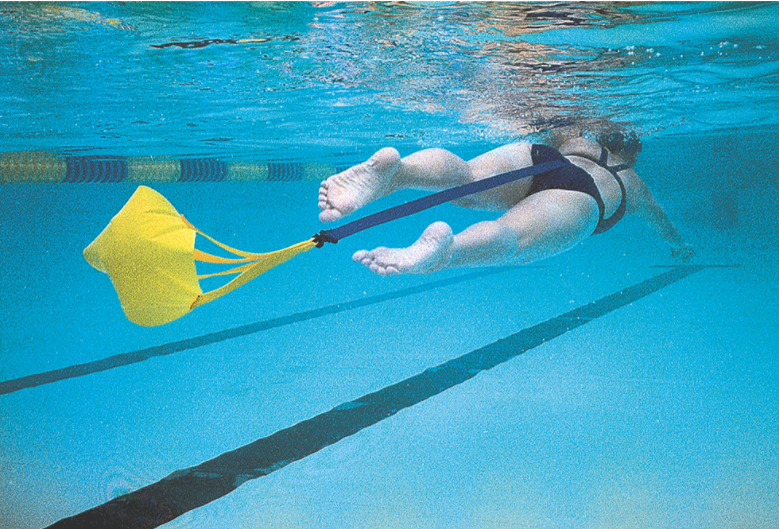
“We do some kind of work with added resistance, usually about two to three times a week,” Stickels said. His group uses equipment like weighted socks, power towers, and parachutes to create added drag for swimmers. This approach forces them to create more force in the water.
Almost all of the coaches pointed to the usage of similar equipment, for the same purpose of building strength under duress. To Salo, though, each piece of gear has a unique function, even if they all apply drag.
“Stretch chords increase resistance as you get away from the origin. Power towers are consistent resistance that will pull you backward. And parachutes provide unlimited resistance as you move,” Salo said. “All of them add additional stimuli to your overall results.”
Using the equipment, swimmers can test themselves in different ways, all leading to the creation of power. Still, Salo cautioned against the usage of this gear without a proper focus on technique.
“The key element to getting the most out of this work is doing it at a racing tempo, without compromising mechanics,” Salo said. “The specificity of the training is very important.”
University of Tennessee head coach Matt Kredich stressed that the work, mixed with the mechanics, can be essential.
“Adding the resistance, and then swimming without it, allows us to feel maximum efficiency,” Kredich said.
Attaining Assistance
Training with resistance certainly aids a swimmer’s ability to work to create speed. But what about assistance? Interestingly enough, making the swim “easier” for the swimmer is something that can build speed, in a variety of ways. Paddles and fins are the most common methods of assisted swimming. John Long Jr, assistant coach at Indiana University, emphasized that this gear allows swimmers to feel their position in the water, and easily simulate fast swims.
“They provide a way to replicate power, without having to go fast,” he said. “It allows you to put pressure on the water, and manipulate your core engagement, so that you can move in the ideal body position.”
Fins and paddles are the most accessible equipment that Long Jr. uses to help swimmers’ placement in the water. They are far from the only method, though. The coach listed assisted chords and a device that can tow swimmers 50 meters as key components of his group’s training. His next experiment? Open water buoyancy suits.
“The hips will ride nice and high, and you can swim in a different position than you would normally swim aerobically (in a buoyancy suit),”Long Jr. said. “It’s just about being creative in getting our swimmers in the (body) position we’re looking for.”
Suiting Up
Generally, the coaches viewed assisted swimming as a beneficial tool, one that could cause little harm. There was one tool, however, that caused some differences in opinion among the group.
Technical suits have been a source of controversy since their debut, making it no surprise they caused a stir. Over the years, though, studies have shown the suit’s ability to provide a significant difference in swimmer performance, “reducing drag by 4.4 to 6.2 percent, and the amount of energy needed by 4.5 to 5.5 percent.” In comparison to a practice suit, some believe that training in the suits can be beneficial.
“The feel on underwaters and walls, especially, is really different,” said Kredich. “We want them to get accustomed to what they’re going to experience in a race.”
Long Jr. indicated that Indiana similarly suits up during training. He referred to wearing the technology as a way to collect information on his athletes.
“It’s a way for me to get data points, so that I can make adjustments (in training), based on their success,” Long Jr. said.
The coach was quick to point out, though, that there were some serious drawbacks to suiting up often. Racing too much with the suit, he explained, could be detrimental mentally.
“Some people don’t manage racing so often well emotionally,” Long Jr. said. “It’s a learning curve to make sure they can race and use it as information, without the emotional stress that comes with high-level racing.”
Others indicated that excessive use of the suit could lessen its hypothetical impact on a swimmer’s important races.
“I don’t like taking away that supersonic feel too often,” Stickels said. “I don’t want to de-sensitize them when they put the suit on for a race.”
Overall, though, the coaches agreed the suits are beneficial, even if their opinions on usage varied.
“The breakout, the kick, the body position, the suit helps with all of that, that’s why we do it,” Salo said. “We’ve just (have to) find a way to not overdo it.”